Friday, 16 July 2021

1798 Rebellion Project Part 2: Skirmishers and Pikes

I started another batch of figures after finishing the first pike group. This time I painted another group of 10 pikes and a group of "Rebel Scouts", skirmishers armed with muskets and blunder busses.


Trent Miniatures seem to vary in style, making me believe that a few different sculptors worked on this range. These skirmishers have a cartoonish look that I think is very charming. I enjoyed adding character to each of the faces in the group.


The rebels often wore ribbons around their hats. Many of these bore slogans such as "Liberty" or "Erin Go Bra" as shown here. "Erin Go Bra" is a corruption of the Irish language phrase "Éireann go Brách", which means "Ireland forever". Few rebels were speakers of the language. 


This one is probably my favourite out of the whole group


As you can probably see, I should have dusted off these models before taking the photos - there's a lot of static grass and dust still on them!


The pack of rebels with firearms contained 8 figures, these two were left over. They'll be mixed into the pike blocks once I have more rebels with guns painted.


This flag was flown at Kilcullen (Co. Kildare). 

            Have you noticed that I quite like                                     painting flags?


Monday, 12 July 2021

Big Spanish Civil War Project Part 10: The Terrain for Spain!

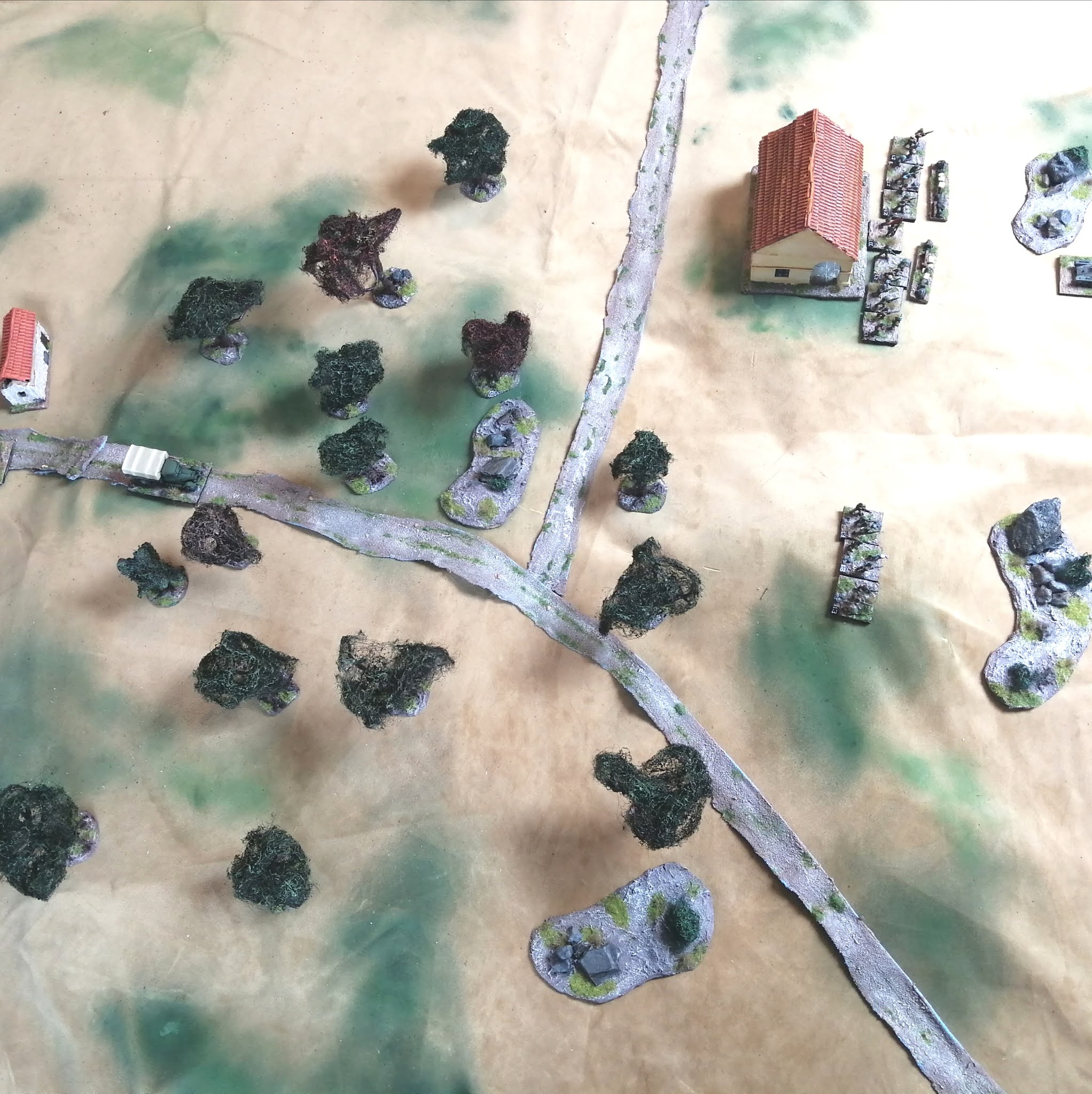
 This week saw the completion of the terrain for the Jarama scenario. I finished off a batch of trees as well as some rough ground. The high ground was made using layers of cardboard, which were glued together and placed under the base cloth to create smooth gradients. They're not very easy to see in the photos, as everything is the one colour, but they add a nice height variation to the battlefield.

The tree-covered plateau is at the centre, while International Brigade troops defend the Casa Blanca on the right. 


The trees were made using florist wire, covered in Milliput. Steel wool and dried tea leaves were used for the foliage!


The dirt roads were made from school uniform, caulk and texturing materials!

One of the rough ground areas. I used rocks from the garden and texture paste. The bushes are steel wool and tea leaves again. 


Another view. 


I have a some days off this week, so I hope to start playing the game. Part 11 of this series is going to be a battle report of the first day of the battle. 

Thanks for reading, 

Go dtí an chéad uair eile, beir bua! 

Wednesday, 7 July 2021

1798 Rebellion Project Part 1: The First Group of Pike

 In my introduction to this project, I discussed the omnipresence of the 1798 Rebellion in the landscape of Wexford. Just a few days ago I was surprised to find yet another monument to the event while walking to work. This plaque is outside the cemetery on John St, Wexford.


Unfortunately, I can't find any further information on Richard Monaghan using the internet.  If anyone knows of sources on the topic, please send them to me! He could make for a very interesting Sharp Practice leader.

This is the statue of "The Pikeman" in the Bullring, Wexford. It was put in position in 1905, and was sculpted by Oliver Sheppard, who also designed the famous "Death of Cú Chulainn". This area is currently being used for outdoor dining as part of coronavirus restrictions - yet another example of the rebellion 's presence in everyday life here! 


I got started with the land forces for the rebellion by painting up a Group of pikemen. I've never painted a pike block before, so I looked forward to getting them done. My favourite details are the faces, which I used to practice glazing, and the flags, which are made from aluminium drink cans with hand drawn designs.

In the 1798 supplement for Sharp Practice, "pike" groups have firearms mixed in, and therefore can fire using 50% of the usual number of dice. I haven't painted any rebels with guns yet, but I'll scatter a few through the pikes when I do.


I painted the "MWS" flag after seeing it in "The Uniforms of 1798-1803" by F. Glenn Thompson. These initials may have stood for "Murder Without Sin" or "Marksmen of Wexford : Shelmalier".

 Further research after I had finished the unit showed that the flag was flown at the massacre of Wexford Bridge. In this atrocity, 37 local Protestants were murdered after being tried in kangaroo courts. This was solely because of their religion, and based on the assumption that Protestants were inherently anti-Irish. The Republican ideals of the Society of United Irishmen were to unite people of all backgrounds in a sovereign state. This did not always translate into reality, and sectarian acts did occur.

 I think historical wargaming is an act of history, in that it is a representation of the past rather than a recreation of it. My representation of the Republicans will undoubtedly be biased in their favour, as I have always sympathised with them. However, I think it's important that I attempt to be as accurate as possible.

 I considered changing the flag because I felt uneasy about its meaning, and worried it would be disrespectful to the victims. However, I decided to keep it as a contrast to the other portrayals of the United Irishmen I will create. While in the main these portrayals will be positive, I've kept this flag to give a more nuanced view of the period.

I haven't posted anything about the Big Spanish Civil War Project for some time now, but it hasn't fallen by the wayside! I've been building some terrain bits which are very nearly done. They'll be the subject of the next post in the Project, which will hopefully be the final update before the game itself!. 

Tuesday, 29 June 2021

The United Irishmen Uprising of 1798: A New Project

"Until... on Vinegar Hill... the final conclave.

Terraced thousands died, shaking scythes at cannon.

The hillside blushed, soaked in our broken wave.

They buried us without shroud or coffin

And in August... the barley grew up out of our grave."

- Séamus Heaney, "Requiem for the Croppies". 

Battle of Vinegar Hill, Enniscorthy, Wexford. 


There comes a time in many historical gamers' lives when they are drawn to the Napoleonic era. Since the very beginning of wargaming, the period has ranked among the most popular of subjects, and not without good reason. The Napoleonic Wars were a time of great personalities, ridiculously ostentatious uniforms and the clash of recognisably modern nations. They are a Europe-spanning tale of an almost legendary quality.

But I'm not going to do Napoleonics the usual way. I'm not going to drive the French out of Spain or try to take Moscow. I won't be painting big units of richly adorned troops. The subject I've chosen didn't even involve Napoleon that much. The 1798 Rebellion would perhaps be best described as a part of the French Revolutionary Wars instead. 

It recently struck me that I became interested in each of the historical armiess I've painted through personal or cultural connections to them. My Ulster Cycle army was the result of years spent reading Irish myth, and seeing it reflected in the land around me. My interest in Ethiopian history arose from family connections to the country. The Irish members of the International Brigades left for Spain from a port right next to where I live. 

I have many connections to the United Irishmen's Uprising. It is commonly seen as a defining aspect of the identity of Wexford, my home county. At school, I used to eat lunch on the site of an arms factory that supplied the rebels! My mother's workplace is at the foot of Vinegar Hill, the site of the United Irishmen's final defeat. You couldn't go anywhere in Wexford without passing a memorial of some kind to the rising.

The importance of the rebellion to Irish history is immense. It began the tradition of Irish republicanism and the belief in Ireland as a sovereign nation of united peoples. It is difficult to imagine an independent Ireland without the uprising, as despite its failure it laid the ideological groundwork for later Irish republican movements.

The Ireland of the 18th Century was home to a fiercely divided society. Since the Plantations of the Tudor era, the power of Gaelic Ireland had been destroyed, and the mostly Anglican planters had been installed in positions of power. These were known as the Protestant Ascendancy. The majority, who identified as Irish and who were overwhelmingly Catholic, were subject to harsh Penal Laws, which imposed great restrictions on political and civil rights as a means to deter rebellion. Presbyterians possessed more rights than Catholics, but were not granted equality with Anglicans.

The United Irishmen were founded as a parliamentary reform group in these circumstances. Theobald Wolfe Tone, a young Presbyterian lawyer, was among their founders. His stated aim was "To unite the whole people of Ireland, to abolish the memory of past dissensions, and to substitute the common name of Irishman, in place of the denominations of Protestant, Catholic and Dissenter". It was not long before the United Irishmen became a revolutionary movement, inspired by the French Revolution. The seeds of the "Tree of Liberty" had indeed fallen in Ireland.


Wolfe Tone, "Father of Irish Republicanism". 

For this project I am going to build two armies for Sharp Practice. I have tried a few TooFatLardies games in the past, and I really like their style. I think that the focus on individual leaders will work well for this period.

I'm going to use 28mm models from Trent Miniatures, who specialise in the French Revolutionary Wars period. They're nice, chunky miniatures in an old school style. They often come with multiple heads or weapons, despite being metal figures. This allows a bit more customisation. 

A beautiful sight


I've been painting some 3D printed 1/1200 scale ships to represent the "Expédition d'Irlande" launched by the French to aid the rebels. I had initially thought they would be a standalone project, but I might as well do the land troops as well. It might be fun to connect the two together in a campaign. I'll be showing them off in a future post! 
The Battle of Five Armies : A Hordes of the Things game

 26th June was my 20th birthday, and to celebrate my friends Tuan, Roachey and Wen Geng came over for a big Hordes of the Things game. We played a scenario based on the Battle of Five Armies from "The Hobbit". Tuan and I took command of the Goblin and Wargs while Roachey and Wen Geng led the Elves, Dwarves and Men. It was our first face to face wargame since the start of the coronavirus pandemic. 

The scenario allowed for the arrival of reinforcements for both sides after set numbers of Army Points were lost. These consisted of Thorin, Beorn, the eagles and some sneaky Goblins. 

Here are a few pictures from the battle. The Elves, Dwarves and Men are defending the high ground while the Goblins are approaching the town of Dale at the centre if the board. 

The game saw the Goblin-Warg alliance being victorious, with a score of 18 - 16. Unfortunately we didn't have time to play the game to its conclusion, but it was really enjoyable. I've never played a game this big before, and I hope to do so again! 

The starting deployment 

All 3 evil commands advance on the beleaguered Dale garrison
The trolls break down the gates and capture the town
My Warg command charges into the Dwarves' and Men's lines 


But are quickly repulsed! 


Unfortunately I don't have any more photos.
It was a fantastic game! 


Thursday, 24 June 2021

Big Spanish Civil War Project Part 10

 This week I finished the last unit I need for the Jarama scenario, a Nationalist Heinkel He-51. It's a 1/72 scale kit from ICM. It was quite fiddly to put together and I'm not fully satisfied with my results, but I'm really happy just to have it done. The base is a 40mm round, which is too small for a model of this weight. It's quite unstable so I think I'll make another one. Like my Polikarpov, the Heinkel is based on a clear acrylic rod which has been magnetised. For this base I cut the top of the rod at an angle to allow the model to sit at a swooping pose.


Here are some group pictures of the whole collection! 


Republicans: Militia and International Brigades, with Soviet equipment 


Nationalists: Regular Army, Moroccans, Foreign Legion, German and Italian equipment. 


I've started making a batch of trees too. I'm using the wire twist method to make their armatures (TheTerrainTutor has a great video on the topic, as always). I used flower arranging wire from a florist's shop. It only cost €1 for enough to make 13 or 14 trees (!!). They are a mix of sizes, and will be used in the Jarama game.
One of the great things about making trees is that they can work for multiple scales. Some of these will also be used for a 28mm project that's coming very soon. Even small 15mm trees can be used as part of hedges in larger scales. 

The armatures


Bark was added using Milliput and a toothpick

This is a fairly time consuming method of making trees. Many people prefer to use Woodland Scenics premade armatures. However the wire method is hard to beat in terms of price and ability to customise.

Once the trees are done, the only terrain I'll need to make for the SCW game will be a set of roads. There are a few hills in the scenario but I think I'll use polystyrene shapes under the game mat for a more natural look.

Thanks for reading this post! I'm excited to be finishing the project and I'm really looking forward to moving on to the "Secret 28mm Project"! 

Monday, 14 June 2021

Big Spanish Civil War Project Part 9 : The Last of the Infantry and Some Other Bits

 Lots of excitment this week as I've finished off all the infantry for the project, as well as a few extra bits. I started by painting the last militia squad, then moved on to the Nationalist individuals. 


                         Squad/Platoon 3
      The Nationalist staff. Messengers, officers and LMGs


The only miniature I still need for the scenario is a Nationalist aeroplane, which hasn't arrived yet. I wanted to keep making progress on the project, so moved on to some terrain. I painted a failed print of the Casa Blanca as a ruin.


It was painted with the same technique as the standard house. The roof is also made of random scraps, like coffee stirrers and cardboard. 

Still looking for things to do for the Spanish Civil War, I painted up a pair of Italian CV33 "tanks" . These absolutely woeful vehicles aren't necessary for the Jarama scenario, but I've always intended to grow this collection. The scenario is just a target to start off with. 


I'm almost ready to play the game itself. Apart from the Nationalist plane, I'll need to focus on making terrain. I've already started a tree or two, which are taking forever. I'm one of those gamers who find it really difficult to buy terrain, even if it's very hard to make! I really like the look of homemade terrain, though, as I can make it to my own specifications.

Until the next post, beir bua!