Showing posts with label Terrain. Show all posts

Sunday, 28 November 2021

1798 Rebellion Project Part 20 (!): Some Buildings

 This is the twentieth post relating to my 1798 Project. I must admit I hadn't expected the project to last this long! I suspect there will be many more posts in the future. My interest in this period of history has only grown through researching it.

I've made two buildings this week. Most dwellings in 18th Century Ireland were very humble. The majority lived in small cottages. These were usually made of stone or earth. Roofs were normally thatch, with few being slated. The brick "Georgian houses" were not common outside Dublin. Some landlords constructed large manor houses, such as Russborough House and Moore Hall.


The window frames are made of coffee stirrers. 

The plaster texture was made using my basing mix - similar to Stirland Mud. 

This model is based on a drawing of Boolavogue Chapel in Nicholas Furlong's book "Fr. John Murphy of Boolavogue, 1753-1798". After Henry VIII's "Dissolution of the Monasteries" in the 16th Century,  Ireland's abbeys had ceased to exist.  Beginning in the late 17th Century, the Penal Laws limited Catholic worship in Ireland. Services were held at isolated "Mass rocks". Later, thatched buildings were used for religious ceremonies. The village of Tomhaggard, near my home, contains the only Irish thatched Church still standing. 

The model is made of MDF sheet. It's not the easiest material to use for scratch building. But with a sharp knife, superglue and Milliput, it can be used to good effect. MDF buildings are also very durable. The thatch is made from scouring pad.


This model is based on Evoy's forge, which I've previously visited. It's fairly similar to the church in its construction. The stones were added using a thin layer of Milliput, scored with a toothpick.

Just a few days ago I received some more figures for the project. The next job will be painting some rebel artillery!


Go dtí an chéad uair eile, beir bua! 

Sunday, 21 November 2021

1798 Rebellion Project Part 19: Conquering the Lead Mountain

 After completing the French, I still had a few extra models. I decided to paint them up, finishing off the Lead Mountain in the process!


The first piece I made is a French Deployment Point. These are among my favourite things to paint for Sharp Practice, as I can make little scenes. I like painting leaders for the same reason.

Capitane Garnier discusses revolution with Cuan. Kilalla Bay, August 1798. 

The beach was built up with Milliput. The sand is painted snow flock. 

The water was painted straight onto the MDF base. I used gloss varnish on top. 


The flagpole is a wire pike. The Phrygian cap was added with Milliput. 


Next, I painted up another Leader for my United Irish army. I plan on painting every Irish personality that Trent produce - this will give me greater freedom to represent the different theatres of the rebellion.


This is Joseph Holt, a leader of United Men in County Wicklow. Holt was from a Protestant, Loyalist family near Redcross. He was as a farmer, but also worked as a sub-constable, fugitive hunter and a fabric inspector! Holt's Memoirs contain exciting stories about his pursuit of criminals, all told with great relish. In his own words, "my name was to the disobeyors of justice a terror"! 

Joseph Holt led a guerilla campaign against British troops, making use of the Wicklow Mountains. After the defeat at Ballinamuck, the rebels had lost all hope of success. Holt surrendered, and was transported to New South Wales. His fellow Wicklow Captain Michael Dwyer continued the campaign until 1803(!). Holt was pardoned and left Australia for Ireland in late 1812. However, his ship struck a reef. He and his family had to land on one of the Falklands. They would not make it to Ireland until 1814.

I can't believe I'd never heard of Joseph Holt before starting to research this period in greater depth. His life story is just so interesting, and I think he's the perfect Sharp Practice character.

There is debate over Holt's reasons for joining the United Irishmen. In his Memoirs, written in Australia, he claims he was swept up by the rebellion. He does, however, sympathise with the rebels' grievances. This isn't a satisfactory answer. Holt  had been involved in the Society of United Irishmen since 1797, and several of his brothers were also members.  Holt's membership of the Irish Volunteers in the 1780s also suggests a liberal political standpoint. 

Holt took up arms after his home was burned by the Fermanagh Militia. This unit was under the command of local magistrate Thomas Hugo. Hugo owed Holt money; as such, his rebel activities may have been the result of personal rivalries. 


Many of Holt's men were Militia deserters. I've painted this chap in a mix of Militia and civilian clothing. 


Finally, I put together a water cart. In Sharp Practice, these are available as a support option. It's been thrown together from coffee stirrers, cocktail sticks and spare plastic wheels. 


The barrels are from a Warhammer fantasy Ogres kit. A lad at my gaming club gave me some spare bits (thank you very much!). The crate and canteen are the result of my dodgy sculpting.

While I'm waiting for some more minis to arrive, I've started making some buildings for this period. One is based on Evoy's Forge, which I visited this summer. I've posted some pictures of that trip here


Go dtí an chéad uair eile, beir bua! 

Saturday, 30 October 2021

1798 Rebellion Project Part 16: The Halloween Special

 Halloween has always been my favourite time of the year. It's an ancient tradition in Ireland, as Oíche Shamhna ("Samhain Eve"). Such was Samhain's importance that it gave its name to the month of November in the Irish language. Irish myth describes Samhain as a big festival, lasting a week, almost always coinciding with supernatural happenings. The Gaulish Coligny Calendar, dating from the first Century BCE, lists "Samonios" as a month at the end of Summer, evidence that Samhain was a Celtic rather than Irish tradition.

I felt I had to do something wargaming related for Halloween. I decided on some graveyard terrain, as it's particularly suitable for the 1798 Project. At the Battles of Tara, Old Kilcullen and Antrim, the rebels made use of graveyards for cover. Graveyard walls seem to have been the best defence available, especially against artillery.

I did some research on 18th Century Irish headstones, and found some interesting results. Many of them are suitably "gothic"! This website gives information on Donaghmoyline Graveyard in County Fermanagh. It features some unusual round gravestones with skull-and-crossbones motifs, a design found in some parts of Ulster in the 18th century.

All the headstones were made from coffee stirrers and Milliput. 


The two headstones on the right are of the previously mentioned type. They are accompanied by hourglass designs, a grim reminder to the living of their mortality. Scary stuff. 


This is a "box tomb". It was fairly common for gravestones to feature images associated with the crucifixion, and it was easier to add them on a flat surface like this one.

The graveyard itself is just an MDF base with some stone walls made of gravel. I think I might make a few more headstones to fill the empty space. 

        A collapsed section of the wall. 

I've also finished a group of (far less spooky) 60th Rifles for the project. This regiment fought in the American War of Independence before taking part in the 1798 Rebellion. I couldn't find that much information about their involvement in the uprising, but they were present at the Battle of Foulksmills, and fought the guerrillas of the Wicklow Glens. If anyone has further information I'd love to know. Here is one article on the subject. 

The 60th Rifles were among, if not the first British unit to wear shakos and use rifles. They're technically my first ever Napoleonic figures, as they fought in the Peninsular War. You might notice I've painted a certain officer from that conflict to lead them! He's from Tangent Miniatures. 


Go dtí an chéad uair eile, Samhain sona daoibh! 

Thursday, 2 September 2021

1798 Rebellion Project Part 9: Finishing off the British Force

This figure represents General Sir David Dundas, and is the last piece required for the British force in this project. I really like this sculpt; it's as if he's surveying the troops before battle. 

Dundas had a long and storied career, having fought in the Seven Years' War before being appointed to his role in Ireland. 

I've given his horse a dapple grey coat. This was painted using the stippling technique. I started with a grey basecoat with a shade colour glazed into the recesses. The highlights were applied using lots of little dots. In some areas, I used a glaze of the base colour to tone the dots down. 

With all the Brits done, I made a Deployment Point. These are quite important for Sharp Practice. Players are allowed to deploy their troops from them, so their positioning is very important and provides a range of tactical options. 

I went for a white canvas tent to represent my first Deployment Point. I used artwork from the 18th Century as inspiration, such as this picture:

I made a substructure from cocktail sticks. The canvas was made by cutting shapes from an old scrap of linen, and was attached using super glue. I primed and painted the whole thing, which gave it a lot more strength. The tent was kept separate from the base until the interior details were finished. 

There was a big gap in this corner of the tent, caused by my bad cutting skills! I made a patch to hide my mistake, and added a few extra around the tent to make it look intentional. This patch was painted using the MacKay tartan, which was worn by the Reay Fencibles during the rebellion. It's far from perfect, but I like it 😊
The bed and chest were sculpted straight onto the base with Milliput. I painted them before adding the tent over the top. 
I added a cavalry sabre from the bits box to the top of the chest. 

I really enjoyed making this, and I'm looking forward to doing more. I haven't had many ideas as to how to represent the other Deployment Points, so if anyone has suggestions I'd love to hear them!

Go dtí an chéad uair eile, beir bua! 

Monday, 12 July 2021

Big Spanish Civil War Project Part 10: The Terrain for Spain!

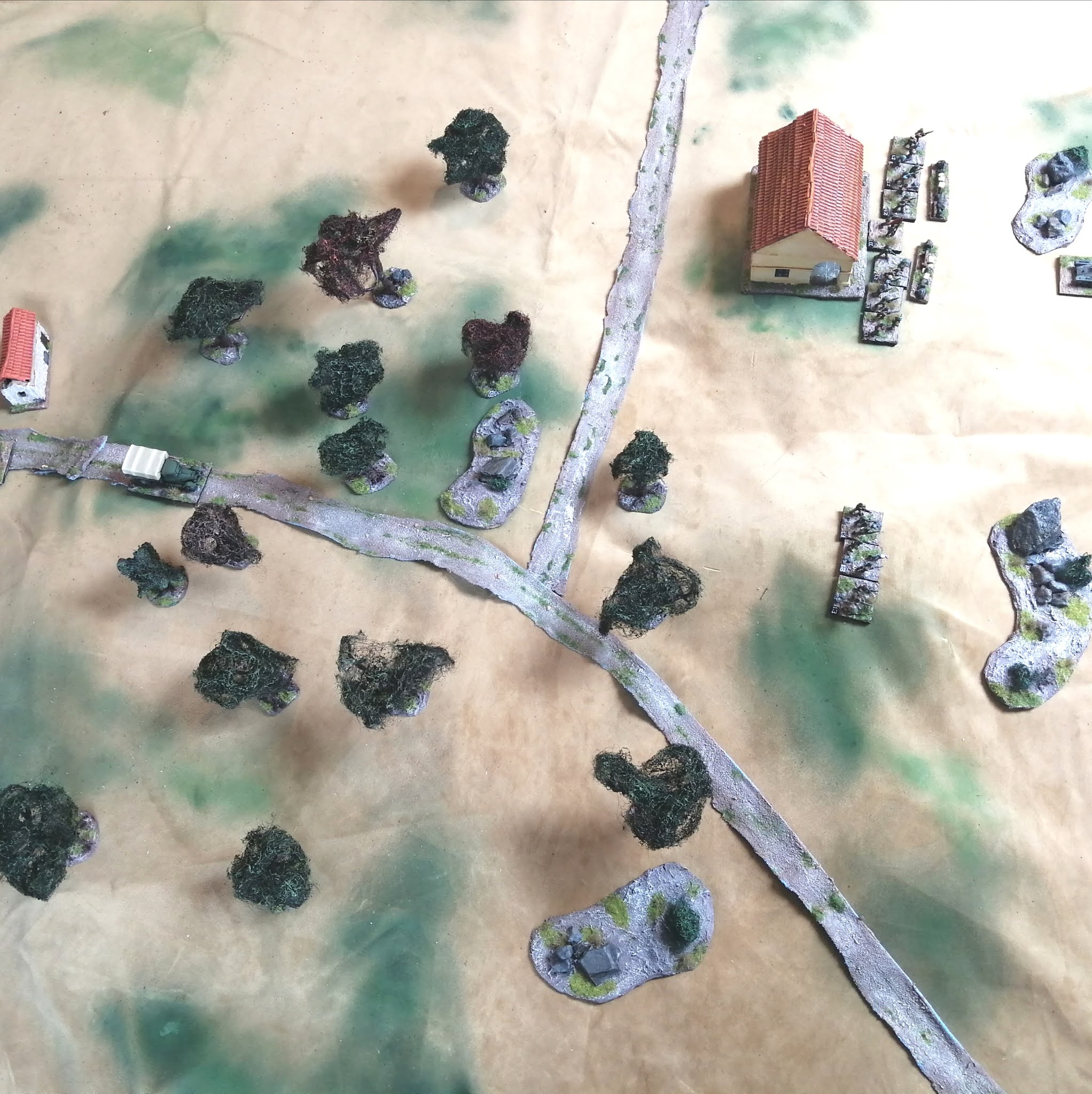
 This week saw the completion of the terrain for the Jarama scenario. I finished off a batch of trees as well as some rough ground. The high ground was made using layers of cardboard, which were glued together and placed under the base cloth to create smooth gradients. They're not very easy to see in the photos, as everything is the one colour, but they add a nice height variation to the battlefield.

The tree-covered plateau is at the centre, while International Brigade troops defend the Casa Blanca on the right. 


The trees were made using florist wire, covered in Milliput. Steel wool and dried tea leaves were used for the foliage!


The dirt roads were made from school uniform, caulk and texturing materials!

One of the rough ground areas. I used rocks from the garden and texture paste. The bushes are steel wool and tea leaves again. 


Another view. 


I have a some days off this week, so I hope to start playing the game. Part 11 of this series is going to be a battle report of the first day of the battle. 

Thanks for reading, 

Go dtí an chéad uair eile, beir bua! 

Thursday, 24 June 2021

Big Spanish Civil War Project Part 10

 This week I finished the last unit I need for the Jarama scenario, a Nationalist Heinkel He-51. It's a 1/72 scale kit from ICM. It was quite fiddly to put together and I'm not fully satisfied with my results, but I'm really happy just to have it done. The base is a 40mm round, which is too small for a model of this weight. It's quite unstable so I think I'll make another one. Like my Polikarpov, the Heinkel is based on a clear acrylic rod which has been magnetised. For this base I cut the top of the rod at an angle to allow the model to sit at a swooping pose.


Here are some group pictures of the whole collection! 


Republicans: Militia and International Brigades, with Soviet equipment 


Nationalists: Regular Army, Moroccans, Foreign Legion, German and Italian equipment. 


I've started making a batch of trees too. I'm using the wire twist method to make their armatures (TheTerrainTutor has a great video on the topic, as always). I used flower arranging wire from a florist's shop. It only cost €1 for enough to make 13 or 14 trees (!!). They are a mix of sizes, and will be used in the Jarama game.
One of the great things about making trees is that they can work for multiple scales. Some of these will also be used for a 28mm project that's coming very soon. Even small 15mm trees can be used as part of hedges in larger scales. 

The armatures


Bark was added using Milliput and a toothpick

This is a fairly time consuming method of making trees. Many people prefer to use Woodland Scenics premade armatures. However the wire method is hard to beat in terms of price and ability to customise.

Once the trees are done, the only terrain I'll need to make for the SCW game will be a set of roads. There are a few hills in the scenario but I think I'll use polystyrene shapes under the game mat for a more natural look.

Thanks for reading this post! I'm excited to be finishing the project and I'm really looking forward to moving on to the "Secret 28mm Project"!