Thursday, 29 October 2020

Conall Beag


I just finished painting this miniature from Monkstone Miniatures. They're making a very interesting range of fantasy figures with a unique look. This one is "Rollo the Masterful", but Conall Beag (Conall the Little) is the name that came to me for him. 

I had a lot of fun experimenting with this colour scheme. Purple and turquoise are two of my favourite colours, but I haven't painted many figures with them. I imagine the scheme to be Conall's knightly heraldry. 


Saturday, 10 October 2020

Sebastopol Mortar (build)

 I've long wanted to build an Ethiopian army for Hordes of the Things. Recently, I've been doing some research into what such an army might look like. I ended up reading about "Sebastopol", a huge mortar commisioned by Tewodros II in the 1860s. 

The gun weighed 6.7 tons and could fire around half a ton of ammunition at a time! Although an indication of its power, Sebastopol's great weight was its undoing. As far as we know, it was never fired in battle. It was simply to heavy to be mobile. 


A contemporary illustration 

The barrel of the mortar today 


A replica Sebastopol, now on a roundabout in Addis Ababa

"Sebastopol" is a strange name. It refers to a city in Crimea, but I couldn't find any information as to why a mortar was given this name. Tewodros fought against the British, who had previously besieged Sebastopol. However, this was a British victory, so the name of the weapon probably wasn't ironic or insulting. 

This history is very inspiring, so I started thinking about how I would include it in my future army. It will be classed as Artillery, possibly as a General element for extra power. I imagine that as being Tewodros cheering on his creation! 

I remembered I had a 28mm scale mortar I got free with some Alternative Armies figures. I checked it for scale beside some 15mm figures and it was quite accurate to the size of Sebastopol, so the conversion work began! 


I added extra bands around the barrel using Milliput, then cut the base down into a square. 


I used some old matchsticks to make the undercarriage 


One thing became clear to me at this point :I needed wheels! This is a challenge, as spoked wheels are not easy to make from scratch. I just got a Snotling Blood Bowl team in the post today, and one part stood out to me. As you can see in the picture, the box contains spoked wheels. 
I wanted to copy this part using a Milliput mould. First, I covered the wheel in some talcum powder, then I pushed it into Milliput. The powder helped me to pull the wheel out again. Once the putty hardened, I had a perfect impression of the wheel! Using talcum powder and Milliput again, I stamped out copies of the wheel on old wet pallette paper (another material Milliput won't stick to). 

I'm really happy with how they turned out! But I had lots more to do before finishing the wheels. Two of Sebastopol's wheels are slightly wider than the others, so I had to use a different method. I gave sculpting them by hand a try. 

I used a paint bottle lid to stamp out a circle into epoxy putty, then hollowed out the middle with a sculpting tool. I carved some wood texture into the wheel. 

For the spokes, I took a toothpick and drilled evenly spaced holes around it with a pin vice. I used these to attach paper clip wire. Then I cut the wire down to size and glued the whole thing into the wheel. They took a long time to make, but I'm happy with them. 

I sanded down the backs of the wheels and glued them on. They're not as straight as I'd like, but I'm really happy with how the model turned out! I put it on a 40mm square base for Hordes of the Things. Lastly, I added two matchsticks on the carriage to be more accurate to Sebastopol's shape. 


I might add some chains around the wheels later, but for now the construction is done. I have a lot of other projects at the moment, but I'm looking forward to painting this one! 


Tuesday, 8 September 2020

The Silver Pinnacle Slayers

I painted this Dwarf Blood Bowl team back around the start of Lockdown, having wanted to start the game for years. I chose Dwarfs as my first team because they are very resilient players who are also well able to dish out damage!

I decided to go with NMM for the metal parts of the figures. I'm very happy with how it turned out. Apologies for the poor quality of the photos. 

A group shot of the whole squad!

My favourite players on the team are the Troll Slayers. These guys are very strong, and are able to hold their own against most other teams. Their main downside is their "Frenzy" special rule, which makes them recklessly pursue their opponents. 

I painted runic tattoos on both of them, although they might not al be visible in the photos. 


Two Blitzers:


The three different poses of Blockers (also referred to as Longbeards). 


Finally, two Runners. These are the "fast" players on the (notoriously slow) Dwarf team. They're great for running into the End Zone for a touchdown. 


I plan on painting up some Star Players and Secret Weapons for this team. Every Dwarf team needs a Deathroller sooner or later! 


Monday, 7 September 2020

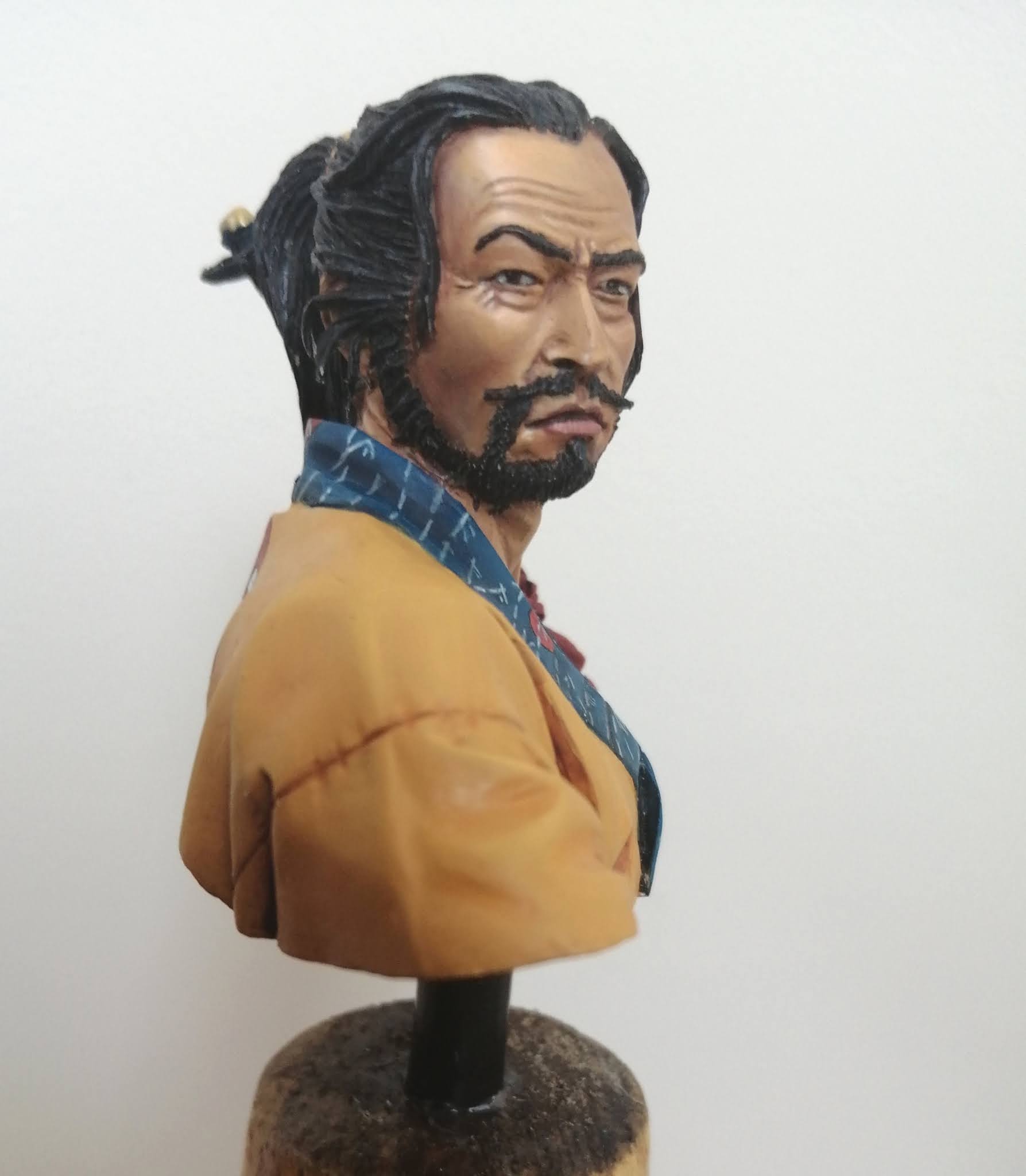
Pegaso Ronin Bust

 For my birthday this year, I got a very nice resin bust from Pegaso. Initially I wanted to paint him as Musashi Miyamoto, a samurai of almost legendary renown. I decided against this later on, instead employing a style inspired by the music of Shing02 and artwork from Samurai Champloo.


I tried out some new techniques on this figure. I wanted to create a "Rembrandt lighting" effect. This means that half the face is hit by light, while the other side is in shadow. I'm happy with the result, but I think I should have increased the contrast between the light and dark areas. 

The pattern on the collar represents a bamboo forest under a rising sun, and is repeated around the figure. 


The image on his back was painted in a cartoon style, inspired by the visuals of Samurai Champloo. 


The Averland Adventurers

 These little folk are my new Halfling Blood Bowl team. They're great sculpts with a lot of charm. I did a few conversions on some of the players to make them more unique, and to allow me to use Star Players. Their kit is inspired by FC Barca's Catalan shirt. 

Here's a group photo of the whole squad! 


These two are Hefties, particularly tough Halflings. I like their design, both of them look like they're seasoned fighters (even if they're not exactly great!). I sculpted a scarf for the one on the right and gave him an extra shoulder spike so that he can be used as Puggy Baconbreath. 


These two Hopefuls are posed sprinting up the field. As with all the figures on the team, I really enjoyed painting their faces.


I made stilts for this player. He can be used as a normal Hopeful or as the Star Player Nuddley Verruca. 


This fella looks confident, as if he could be the team captain. 


Two Catchers:


I did a head swap on this Hopeful to make him suitable for Captain Colander. I sculpted a cape for him from Milliput too. Painting chequered clothing is always a challenge, but fun. 


This is another converted Hopeful. I combined two heads from the kit and sculpted some curly hair. He can be used as a standard Hopeful or Big Jobo. 


A fairly normal Hopeful :


Player number 6 is one of my favourites. 


No Halfling team is complete without some Treemen, and I'd like to add some soon. I'm not sure which miniatures I'll use for them, but I might try the Treemen from the Warlords of Erehwon range. The box includes 3 different sculpts, so it's perfect for a Halfling team. 


Monday, 31 August 2020

Kilkenny Witch Trial Chess Set Part 2 : the White Pieces

The Complete Side


 The pawns

These pieces are intentionally nondescript. They represent the many supporters of Bishop Ledrede. 


The Rooks

The rooks are inspired by the round tower at St. Canice's Cathedral. 

The Knights

These represent the agents of the Bishop. 


The Bishops

Since the King on this side has to represent a Bishop, these were made to represent monks. Their design is inspired by the monks' tonsure


The Queen

I found this piece to be the hardest to design. I thought it should represent an ally or second-in-command of the bishop. I decided to carve a person wearing a generic 14th Century hat. The figure represents the children of Alice Kyteler who accused her of several crimes. 


The King

The mighty Bishop Ledrede himself. He was fanatical in his pursuit of Alice and her "witchcraft" 


A picture of the complete set:


Thursday, 27 August 2020

Kilkenny Witch Trial Chess Set - the Black Pieces

Background 


In 1324, Kilkenny businesswoman Alice Kyteler was accused of witchcraft after several of her husbands mysteriously died. The local bishop, Richard Ledrede, believed that his diocese was full of heretics and sorcerers. He was determined to assert his authority over the region, and relentlessly pursued Kyteler. The case led to the execution of Petronilla de Meath, the first person in the British Isles to be burned at the stake for witchcraft. Alice Kyteler herself is believed to have escaped to Britain.

The case is among the most famous of stories from Medieval Ireland, and I have been interested in it from a young age. After a visit to Kilkenny's Medieval Museum last year (which I highly recommend!), I was inspired to design these chess pieces. I've spent this week carving the designs into wood. They are made of poplar stained with black. 

My design philosophy was to create a fairly abstract set of pieces. Since this is an event from many centuries ago, we have little idea about the appearances of the different figures in the story. Yet their personalities are clear from the accounts of the time. This inspired me to create simple pieces that illustrated the personalities involved.

I also thought that chess would be a good medium to depict the political struggle of the time. Much like chess, both sides sought to place their opponents' leader in an untenable position.


The Pieces

Here is the complete black side 

The Pawns


The pawns have two points on their tops. These could represent the pointed ears of a black cat or the horns of a demon. 


The Rooks

These represent Petronilla de Meath, Alice's servant. Both Alice and her son William escaped the Bishop's wrath, likely because of their wealth, while Petronilla was executed as a heretic. Several years later, the roof of St. Canice's Cathedral collapsed under its own weight, and some superstitions claim this was an act of revenge by Petronilla. 

I have depicted her wearing a round cap. She wears her hair in a plait. This piece was especially difficult to research, as there isn't much information on the dress of poor servants. 

The Knights

The knights are the most traditional pieces in this set in terms of design. I have sculpted them as horses. They represent the agents of Seneschal Arnold le Poer, who argued against Bishop Ledrede's prosecution of Alice. Le Poer even had Ledrede imprisoned, but nothing would stop him. 


The Bishops

Ledrede's witnesses claimed the devil had sent Alice Kyteler a Familiar in the form of a shadowy man named Robin Artison. He was said to also appear in the form of a black cat. 

The design of the bishops is very similar to the pawns. Again, the two points on Artison's head could represent horns or cat ears. 


The Queen

The "Queen" in this set is William Outlaw, Alice's son from her first marriage. He was accused of taking the riches of Alice's murdered husbands. Owing to his friendship with Arnold le Poer and his wealth, he escaped execution. He was instead ordered to perform penance and feed the poor. Outlaw also purchased a new lead roof for Canice's Cathedral as a display of repentance. 

He is depicted wearing a conical helmet in the Norman style. 


The King

The "King" of the black pieces is Alice Kyteler, a Kilkenny merchant of Flemish ancestry. She was married four times, and each of her husbands died of strange illnesses. This led to the Bishop's suspicion that she was a witch.

 Some historians believe she may really have poisoned her husbands, so that William could financially benefit. She escaped to England, and there is no further mention of her after the trial. 


In this set, Kyteler is depicted wearing a stereotypical "witch's hat". 


I'm still working on the white pieces, which will represent Bishop Ledrede and his followers. Hopefully I'll have them completed soon.