Showing posts with label Characters. Show all posts

Sunday, 19 December 2021

1798 Rebellion Project Part 22: More Artillery

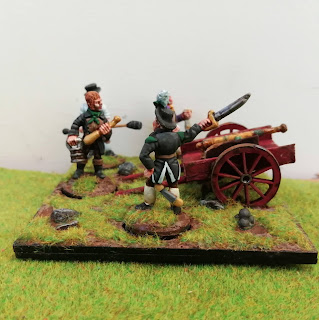
 I've been busy working on some more artillery crews- here are the results! 


The first piece is a rebel-crewed howitzer. At the Battle of Three Rocks, a British relief column, sent from Duncan on Fort to reinforce Wexford Town, was ambushed. This column included two howitzers, which, along with their gunners, were captured. According to Pakenham, both the howitzers and the captured artillerymen were used by the rebels at New Ross. One prisoner, suspected of deliberately missing the British Militia, is said to have remarked "Isn't that a fine shot?" as he blew away a chimney. A rebel responded "it is; but this will be a better one" before shooting the prisoner dead. 

This model is actually a French Gribeauval howitzer, as Trent Miniatures don't produce a British one. 


This crew is commanded by Esmond Kyan. Although a member of the gentry, Kyan became involved in the Wexford Catholic Committee, and may have been one of the founders of the United Irishmen movement in Wexford. Kyan was a colonel of the United Irishmen. 

He had previously fought in the British army, as part of the artillery; he might even have fought on the continent. As such his knowledge was useful to the rebel force. Kyan wore a prosthetic arm, having lost his right arm in a duel with a debtor. This prosthesis was torn off by a cannonball at the Battle of Arklow. Kyan is said to have shouted ‘My loose timbers are flying, God bless the mark . . . now for the right arm of the British line’ in response (according to Furlong's book on John Murphy). 

 He returned to Wexford Town to seek medical aid, and intervened to prevent sectarian murder there. Kyan marched to Wicklow with the rebels, but soon returned to Wexford. He was soon caught and executed. 

This information comes from the book "Fr John Murphy 1753-1798" and this website.

The above engraving is the only image I could use to paint this figure. I chose a model with the closest features I could. I assumed the light coloured hair in the image was blond, but have no idea if this is correct. The right arm was repositioned using a pliers. 


This crew are from the Royal Irish Artillery. This regiment was founded in 1760 from an earlier Artillery Company ("The Uniforms of 1798-1803", F. Glenn Thompson). Furlong states 16 members of this regiment were captured at Three Rocks. 

One of their guns (I think it's a 12 pounder) is on display at Collins Barracks, Dublin. Its undercarriage is painted black, but I believe it is a reconstruction. Thompson's book on the uniforms of the period states this regiment painted their cannons' carriages grey.

In other news, I'll be participating in this year's Analogue Hobbies Painting Challenge, which begins on December 21st. It's my first time taking part. I'm looking forward to it as I've been enjoying the great work of the Challenge participants for a few years now. 
Best of luck to everyone involved! 


Go dtí an chéad uair eile, beir bua! 

Thursday, 16 December 2021

Ral Partha Dwarf Thief

 I haven't painted any fantasy figures in ages, so I got this lad from my FLGS. He's a "Dwarf Thief" from Ral Partha Europe, and is quite suitable for this season. He seems to be in the Kevin Adams style, but seems a bit small. Either way, I really enjoyed painting this model!


Sunday, 5 December 2021

1798 Rebellion Project Part 21: Homemade Artillery!

 Something a bit different this week: improvised artillery! I've been planning on painting rebel artillery for a while now. As soon as I read about this particular cannon I knew I'd have to include it in my army!

In Thomas Pakenham's "The Year of Liberty", the author describes a ramshackle cannon used by Henry Joy-McCracken's men in County Antrim. The rebels had possession of an old Irish Volunteers cannon barrel. The barrel had been buried under a church for safekeeping. The rebels had to mount the barrel on an old civilian cart. The gun's "cradle" was hewn from a log.

Pakenham notes the instability of such a weapon, as it was not built to withstand the force of recoil. He notes it was soon put out of action, possibly as a result of this. Furlong's account of the Battle of Vinegar Hill in "Fr. John Murphy" also describes a cart-mounted cannon. As part of the defence of Enniscorthy, a 4 pounder on a cart was used at the town bridge. Furlong refers to it as a "morale stiffener"; it is unlikely to have been very effective. Regardless of its real world performance, this model is a fun way to represent rebel artillery. 

Among the crew is a sharply dressed fellow armed with... socks? He's another character from Antrim as described by Pakenham. He states that a Quaker haberdasher provided the rebels with grapeshot cartridges by filling socks with musket balls. 


The gun is made of a spare Trent Miniatures barrel, coffee stirrers and wheels from Warbases. 


I've also painted another rebel leader. This time it's Michael Dwyer, "The Wicklow Chief". He was a contemporary of Joseph Holt who fought in the Wicklow Mountains. Dwyer is notable for continuing a guerilla campaign until 1803.  

Dwyer was transported to Australia, where he later became a Chief of Police. He was frequently under suspicion of fomenting rebellion among the Irish in Australia, but this is unlikely. Dwyer was ultimately dismissed from his police job for drunkenness. Declared bankrupt, he was imprisoned and became ill, dying in his early 50s.


Go dtí an chéad uair eile, beir bua! 

Sunday, 21 November 2021

1798 Rebellion Project Part 19: Conquering the Lead Mountain

 After completing the French, I still had a few extra models. I decided to paint them up, finishing off the Lead Mountain in the process!


The first piece I made is a French Deployment Point. These are among my favourite things to paint for Sharp Practice, as I can make little scenes. I like painting leaders for the same reason.

Capitane Garnier discusses revolution with Cuan. Kilalla Bay, August 1798. 

The beach was built up with Milliput. The sand is painted snow flock. 

The water was painted straight onto the MDF base. I used gloss varnish on top. 


The flagpole is a wire pike. The Phrygian cap was added with Milliput. 


Next, I painted up another Leader for my United Irish army. I plan on painting every Irish personality that Trent produce - this will give me greater freedom to represent the different theatres of the rebellion.


This is Joseph Holt, a leader of United Men in County Wicklow. Holt was from a Protestant, Loyalist family near Redcross. He was as a farmer, but also worked as a sub-constable, fugitive hunter and a fabric inspector! Holt's Memoirs contain exciting stories about his pursuit of criminals, all told with great relish. In his own words, "my name was to the disobeyors of justice a terror"! 

Joseph Holt led a guerilla campaign against British troops, making use of the Wicklow Mountains. After the defeat at Ballinamuck, the rebels had lost all hope of success. Holt surrendered, and was transported to New South Wales. His fellow Wicklow Captain Michael Dwyer continued the campaign until 1803(!). Holt was pardoned and left Australia for Ireland in late 1812. However, his ship struck a reef. He and his family had to land on one of the Falklands. They would not make it to Ireland until 1814.

I can't believe I'd never heard of Joseph Holt before starting to research this period in greater depth. His life story is just so interesting, and I think he's the perfect Sharp Practice character.

There is debate over Holt's reasons for joining the United Irishmen. In his Memoirs, written in Australia, he claims he was swept up by the rebellion. He does, however, sympathise with the rebels' grievances. This isn't a satisfactory answer. Holt  had been involved in the Society of United Irishmen since 1797, and several of his brothers were also members.  Holt's membership of the Irish Volunteers in the 1780s also suggests a liberal political standpoint. 

Holt took up arms after his home was burned by the Fermanagh Militia. This unit was under the command of local magistrate Thomas Hugo. Hugo owed Holt money; as such, his rebel activities may have been the result of personal rivalries. 


Many of Holt's men were Militia deserters. I've painted this chap in a mix of Militia and civilian clothing. 


Finally, I put together a water cart. In Sharp Practice, these are available as a support option. It's been thrown together from coffee stirrers, cocktail sticks and spare plastic wheels. 


The barrels are from a Warhammer fantasy Ogres kit. A lad at my gaming club gave me some spare bits (thank you very much!). The crate and canteen are the result of my dodgy sculpting.

While I'm waiting for some more minis to arrive, I've started making some buildings for this period. One is based on Evoy's Forge, which I visited this summer. I've posted some pictures of that trip here


Go dtí an chéad uair eile, beir bua! 

Sunday, 14 November 2021

Sharpe Diorama

 Here's a small Sharpe diorama I made as a birthday present for a friend. The figures are from Tangent Miniatures' Ahistorical range. I hope he had a great day!


1798 Rebellion Project Part 18: The Completed French Force

 I got lots of painting done this week. So much so that my lead mountain is home to only two figures! I've finished the last models for the French list.

First up is General Jean-Joseph Amable Humbert. Before the French Revolution, Humbert worked as a dealer in animal skins, but rose to become a general. In August 1798, he landed at Killala with the 70th Demi Brigade. The "Republic of Connacht" was then proclaimed by the French, with John Moore (no relation to the British General) as its president. Humbert had initial success at the Battle of Castlebar, and intended to advance into the Irish Midlands. However, his small force surrendered against impossible odds at the Battle of Ballinamuck.

Humbert was taken as a prisoner of war and repatriated. He continued to fight for the French army, and was sent to Haiti to suppress the revolution. Quite ironic considering his activities in Ireland! Humbert was accused of looting while in Haiti and returned to France. He joined rebel movements in both New Spain and Argentina, before fighting in the Battle of New Orleans in 1815. He spent the rest of his life as a school teacher. Like many figures in this period, Humbert is a fascinating character. I'd love to see a detailed biography of his life in print.


That cartridge box caused a lot of headaches


I put together some Shock markers to go along with the force. 


A group photo of the full army:


I had some leftover figures from the British force that I wanted to get painted. Here are the Monaghan Militia Light Company. 


"U wot m8?"

Finally, I made a small holy well. These are very common in Ireland, and have many superstitions attached to them. Although their veneration is entirely Christian nowadays, evidence suggests that bodies of water were important ritual sites in pagan Celtic culture. It's not a substantial piece of terrain, it's just a nice bit of decoration. 

The wall is made of pieces of gravel. The water is gloss varnish. 

I built up the earth texture around the edge to give a stronger illusion of depth.

The Wicklow general Joseph Holt is currently on my painting table. He's another truly interesting character and I can't wait to finish painting him. After that I'll move on to the next stage of the project - artillery!


Go dtí an chéad uair eile, beir bua!